Thinking in Domains: Clarity Leads to Evolution
Jun 26, 2026
Estimated reading time: 7 minutes and 5 seconds
Table of Contents
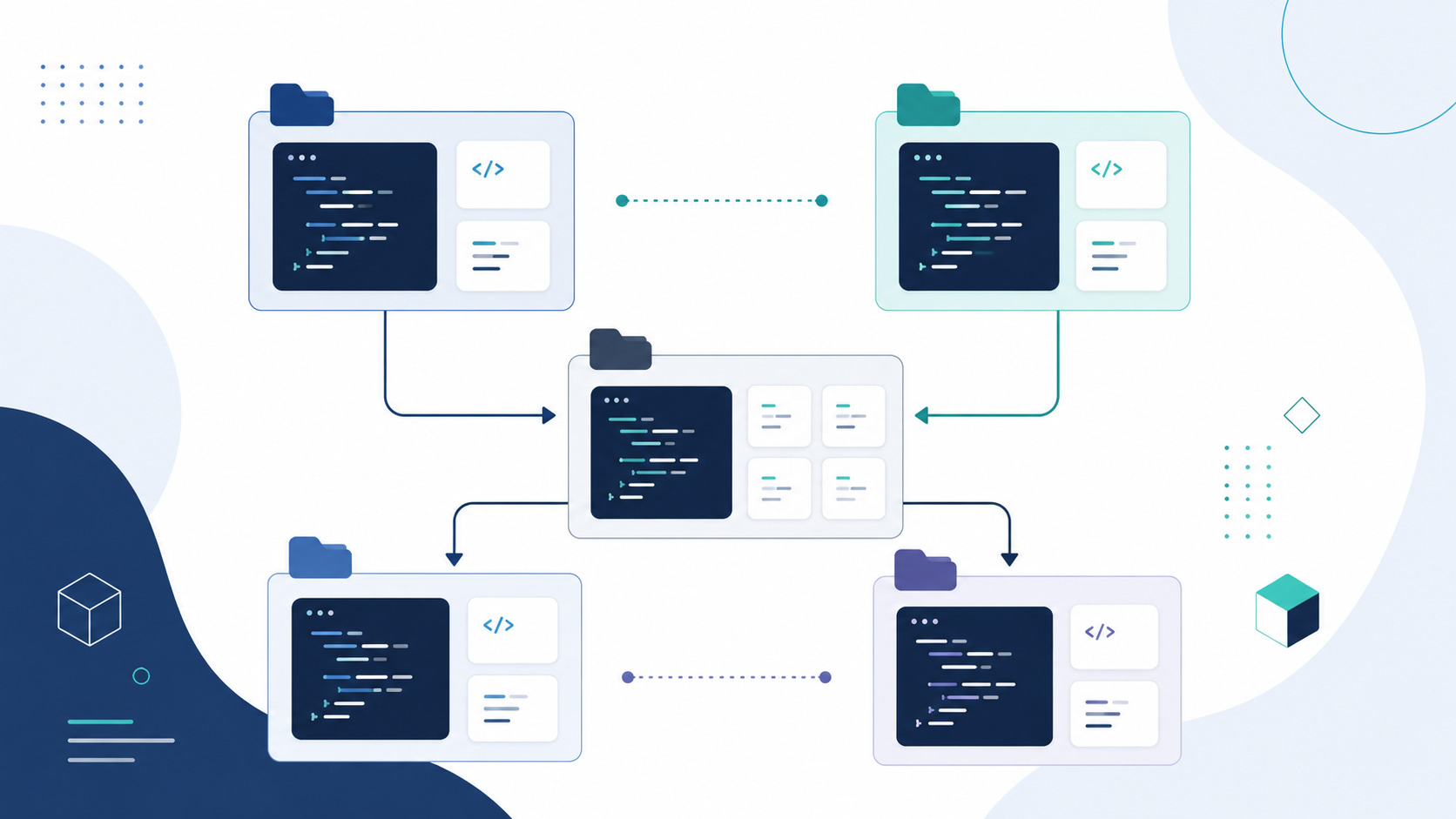
Building software that evolves over time can be challenging, so much so that people have written many patterns and practices for organizing applications. A well-organized piece of software can make it much easier to iterate on, add new features and keep integrations flexible.
One ideal solution is to have an application that is essentially “glue code” connecting different pieces together.
This can be achieved if you design your application in terms of domains.
By structuring your application in terms of domains, you let each domain handle its own logic, state management and business rules, while the application code coordinates these domains to achieve some desired behavior. Thinking this way reduces unnecessary dependencies and creates explicit boundaries, which promotes a modular, extensible and maintainable codebase.
In this article, I’ll explore how to think in domains, which principles support healthy implementations and how these ideas connect to Domain-Driven Design (DDD) and related architectures.
What is a Domain?
I like to define a domain as this:
“A domain is a single logical unit of functionality that encapsulates a set of related business rules and operations.”
In this article, I use “domain” in a practical implementation sense: a cohesive business capability with explicit ownership and boundaries. In stricter DDD terminology, some of these units might be described as subdomains or bounded contexts.
Domains are responsible for the logic that operates on the entities they own and each exposes a well-defined API that applications or other domains can use to interact with it.
I say “other domains” because domains may depend on each other to define higher-level functionality. In an
e-commerce application, for example, Order may depend on Product and Customer concepts to define the business
rules for creating and processing orders. This establishes dependency directions between domains. We will see more on
this later.
The four layers of a DDD application
In his book “Domain-Driven Design” (2003), Eric Evans described principles for structuring applications around a domain model. One of the concepts he presents is a four-layer architecture for applications.
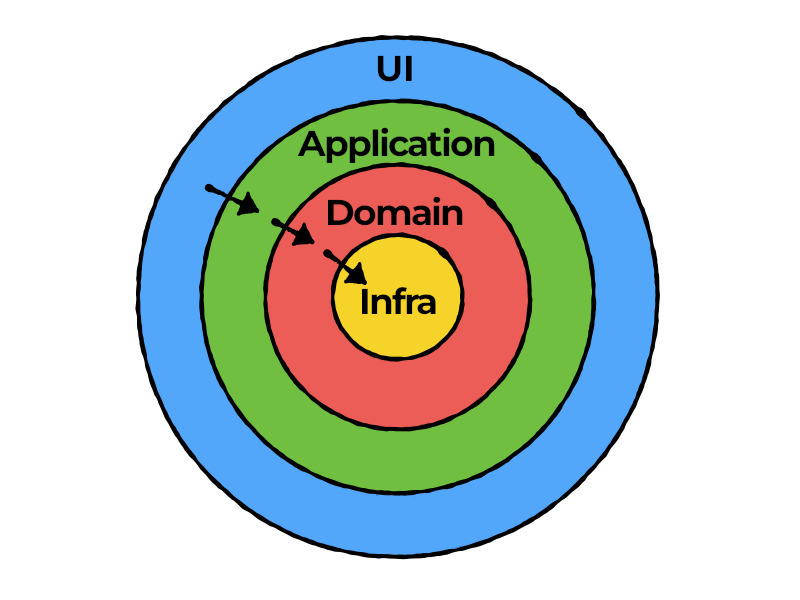
Four layers of an application in DDD
The four layers are, in descending order:
- User Interface: receives user input, calls application use cases and presents results.
- Application: coordinates use cases, transactions and interactions between domain objects or services. It may also map data transfer objects (DTOs), but it does not implement the core business rules.
- Domain: contains the core business concepts and rules, including entities, value objects, aggregates and domain services.
- Infrastructure: implements technical concerns such as persistence, messaging and external service integrations.
This separation reduces a lot of cognitive load from understanding an application because it makes each responsibility clear. It also promotes code hygiene and separation of concerns. If you are not mixing UI code with database models, it is much easier to iterate on and maintain your code.
Example of a domain implementation
Suppose an e-commerce application exposes GET /orders:
- The HTTP handler belongs to the user interface layer. It validates the request and calls an application use case.
ListOrdersServicebelongs to the application layer. It coordinates authorization, pagination and the retrieval operation.- The service depends on an
OrderRepositoryinterface or query contract defined near the application or domain layer. - An infrastructure implementation uses an ORM model or database client to retrieve the data.
- Domain policies and objects enforce business rules when those rules are relevant to the operation.
For a simple read operation, a query service may return DTOs from a dedicated read model. Not every query needs to reconstruct a complete domain aggregate.
Tenets of Domain-Driven Design
Let us look at some of the key principles you need to understand to apply domain thinking effectively to your own projects.
Model domains according to logical boundaries
Think about your application’s high-level components and how they interact with each other. Identify where logical boundaries exist in your mental model and start sketching how they fit together.
For example, if you have an e-commerce application, several domains come to mind:
- Product: manages the lifecycle of products, including inventory, pricing and descriptions.
- Order: handles the creation, processing and fulfillment of orders.
- Cart: manages the shopping cart, including adding, removing and updating items.
- Customer: manages customer information, including profiles and preferences.
- Payment: processes payments and manages transaction records.
Remember that each of these domains is responsible for the logic that operates on the entities it owns, which brings us to the next point.
Domains interact through explicit contracts
Domains abstract a business purpose, so other modules should not import their internal entities or call internal functionality directly. Instead, each domain should expose a well-defined contract that the outside world can use in a controlled manner.
Suppose your Cart domain needs information about the products in a cart. Instead of letting Cart query the
Product database directly, you can use a ProductService application-level API or a public interface to fetch the
required information without exposing Product internals. In a microservices architecture, the equivalent contract
might be a gRPC or HTTP API.
Other valid contracts include events, ports and message-based integrations. The implementation depends on your architecture, but the principle is the same: domains abstract away details, so use their defined contracts.
Dependencies should point toward stable, well-defined boundaries

e-commerce dependency diagram
When drawing a dependency diagram between domains, think about which capabilities are more stable and isolated and which
ones coordinate or build on top of them. Ask how the domains interact with each other. Does it make sense for Product
to depend on Cart? Does Payment depend on an Order or should it receive a payment request through an explicit
contract?
After a few rounds of modeling, you should have a clearer understanding of the system’s dependencies and the boundaries between responsibilities.
A possible relationship between the e-commerce domains is:
Cartdepends on product information.Orderdepends on product and customer information.Paymentdepends on an order or payment request.- An application-level checkout service coordinates
Cart,OrderandPaymentwithout forcing every domain to import the others.
The important point is to make dependency direction explicit and avoid circular dependencies. Circular imports usually indicate that responsibilities are unclear or that orchestration logic belongs in a higher-level application service.
Note: This is not necessarily the optimal design for every system. The correct boundaries depend on your business and product requirements, but the example is sufficient to illustrate the modeling process.
Thinking in domains
To summarize, whenever you are modeling domains, keep these ideas close to your heart:
- Separate the logical capabilities of your application.
- Think about how domains interact with each other.
- Define a dependency graph that follows business ownership and explicit contracts.
In addition to these, borrow Evans’ advice and Model Out Loud:
“One of the best ways to refine a model is to explore with speech, trying out loud various constructs from possible model variations. Rough edges are easy to hear.
- “If we give the Routing Service an origin, destination and arrival time, it can look up the stops the cargo will have to make and, well . . . stick them in the database.” (vague and technical)
- “The origin, destination and so on . . . it all feeds into the Routing Service and we get back an Itinerary that has everything we need in it.” (more complete, but verbose)
- “A Routing Service finds an Itinerary that satisfies a Route Specification.” (concise)
Domain-Driven Design, 2003, page 19
He argues that language is powerful and phrasing a model in different ways helps you identify domain boundaries, dependencies and responsibilities faster.
Conclusion
Should you adopt a domain-driven approach to model your business application? I would argue that, in general, yes. Thinking in domains improves your ability to understand a problem and design modular, flexible and maintainable logical units with clear responsibilities.
Layer separation also helps keep concerns distinct. This makes the codebase more predictable and easier to evolve without forcing every application into the same structure.
If domains are independent, adding new features and managing them can mean:
- Adding a new domain and introducing dependencies through a simple, explicit API.
- Testing modules independently and mocking them at their boundaries.
- Changing business logic inside one domain without spreading the same rule across the codebase.
- Extracting, deploying or scaling a domain independently later, when the operational benefits justify doing so.
If anything, remember that understanding the code is key to maintaining and evolving it.
However, if modeling an application in domains creates too much friction with a framework, consider simplifying your assumptions and stripping away some layers. A framework may already handle infrastructure in a standard way, making a strict separation unnecessarily costly. Prefer the idiomatic way of your language and framework, but keep a domain-based mental model of your application in mind.
When a codebase starts growing faster than its architecture, unclear ownership and tangled dependencies can turn ordinary changes into risky projects. The earlier you identify these problems, the more options you have for correcting them incrementally.
For teams already struggling with these problems, Johntek Consulting provides architecture assessments that turn the findings into a practical evolution plan.
